
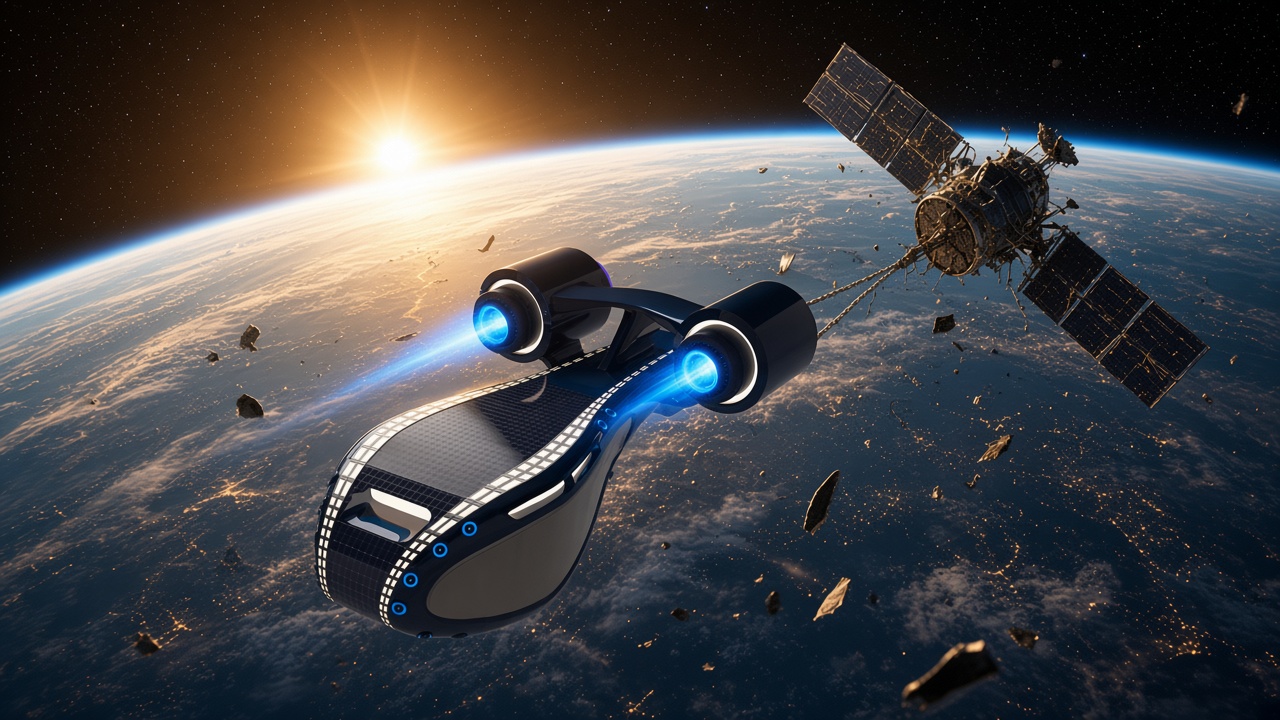
Orbits are getting crowded. Spent stages, defunct satellites, and fragments from old collisions already share the paths that working spacecraft use every day. The Incognito is John Arwood's answer to that problem: a garbage truck in the sky — an orbital debris collection and disposal craft, drawn from a career spent on waste collection and disposal on the ground.
This page is a plain-language overview of the concept as it is described today on Our Purpose, Our Specs, the FAQ, and the rest of incognito.space. It is written for people who build, fly, insure, and invest in space systems, including the leaders of commercial space companies. It does not claim that any of those companies has reviewed or endorsed the idea. If the concept is useful to you, the next step is a direct conversation through Direct Communications.
The problem this craft is meant to solve
From the start of the space age, we have been sending objects into orbit that do not stay useful forever. Communications, mapping, weather, and GPS satellites, along with the boosters that lifted them, have limited lives. When those lives end, much of the hardware remains in orbit. Government and commercial programs in every country with a spaceflight record have added to that cloud of debris.
A 2011 report from the National Research Council, quoted on Our Purpose, put the risk in direct terms: derelict satellites, equipment, and other debris orbiting Earth have been accumulating for many decades and could damage or even destroy satellites and human spacecraft if they collide. Left alone, the problem can feed itself, as collisions create more fragments that threaten still more spacecraft. Some objects fall back and burn up. Others have reached the ground or the ocean, and some of that material is hazardous. Hoping that leftover hardware will simply go away is not a plan.
The same page argues that failing to plan for waste in orbit will stall the very things now growing around it: commercial spaceflight, future exploration, and the supporting infrastructure those ventures need. The Incognito is proposed as a working vehicle for that job — not a slogan about sustainability, but a collection and disposal craft.
What The Incognito is
As described on the site, The Incognito is a self-sustaining orbital spacecraft concept built around three tightly connected ideas: efficient in-space propulsion, a durable power system, and the ability to haul large objects.
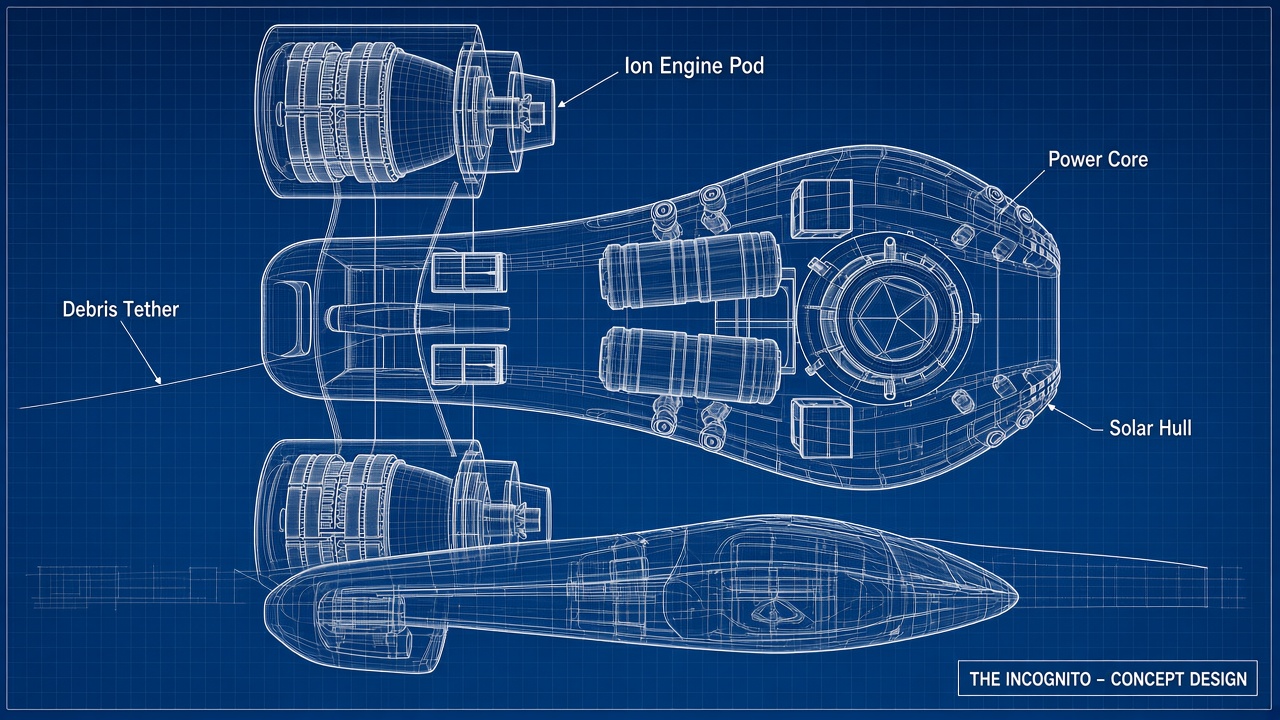
It would use ion thrusters — also described on the site as an electromagnetic propulsion system — so that it needs far less propellant than a chemical stage for the same kind of in-space work. The point, in the site's own words, is to cut how often the vehicle must refuel, and to increase the distance and the weight it can haul. Ion thrusters are not a substitute for a launch vehicle. They are a poor way to leave the ground, and the site's own specs page says so. They are well suited to long, efficient work once a craft is already in space, which is exactly the regime in which debris collection happens.
Power would come from an onboard nuclear reactor, with solar cells around the exterior as backup. The site describes a flexible power distribution scheme: when the vehicle is expected to haul debris larger than its own body, solar power can run the smaller thrusters on the sides while the main power source drives the larger rear thrusters. The result, as the site puts it, is a nearly fully self-sustaining system meant to stay useful on long missions.
Maneuvering is treated as a first-order design feature, not an afterthought. The Incognito is described as having thrusters all across its exterior, so it can make rapid maneuvers. That kind of control matters when the job is to approach, hold, and move large, uncooperative objects rather than to fly a single planned transfer and stop.
The site also stresses versatility. Components could be changed, switched, and attached in space, so the same core vehicle could be configured for debris work, research, or exploration. The strongest feature, the homepage says, is not any one of fuel, speed, or endurance alone, but that flexibility.
What is distinctive about the concept
Several claims on the site are specific to this vehicle and are worth stating carefully, without adding numbers the site does not give.
First, it is framed as a debris hauler, including objects larger than the craft itself, and — on Our Purpose — as capable of hauling satellites twice its size for a longer-than-average time and distance. That is a collection claim, and it is the heart of the "garbage truck in the sky" idea.
Second, the hybrid of ion propulsion, a nuclear reactor, and solar backup is presented as a way to stay on station and to shift power when the load is heavy. In general terms, this pairing is consistent with how electric propulsion is discussed in the public literature: ion systems need a steady source of electrical power, which can come from solar arrays or from a nuclear source, and they trade low instant thrust for high propellant efficiency over long burns.
Third, the vehicle is meant to take on different jobs through in-space add-ons, rather than as a single-purpose tug that must be replaced when the task changes.
Fourth, the Incognito series is described as more than one vehicle. Asteroid mining, on the homepage, would require in-space assembly and two other spacecraft in the series. After that assembly, the combined system would be aimed at S-type asteroids, which the site notes can carry nickel, cobalt, and more valuable metals such as gold, platinum, and rhodium. The site says that work would be possible and inexpensive compared with similar missions. It does not publish a cost, a target body, or a schedule, and this overview does not invent one. A related name, Seraphim, appears on the homepage as "Coming Soon," without a full public specification.
The Incognito is also a versatile platform with defense applications available to qualified government partners on request. That is the extent of the public defense description.
Concept of operations
This is a proposed concept of operations for a debris-collection mission, consistent with the architecture already described on the site. It is not a flight plan, and it does not claim that these steps have been tested on an Incognito vehicle.
Launch. The Incognito would ride to orbit on a conventional launch vehicle. Ion thrusters are for work already in space; the site's own specs note that they are unsuited to launching a spacecraft from the ground. The collection craft begins its job after it has been delivered to orbit.
Low-refuel ion transit. Once on orbit, the vehicle would use its ion thrusters for the transfers that take it to a target and, later, toward disposal. Because ion propulsion uses far less propellant than a chemical stage for the same kind of in-space work, the craft is meant to go longer between refuelings and to cover greater distances with a heavier load — the point of a garbage truck that has many stops, not one.
Locate the debris. The next step is to find and close in on a defunct satellite or other debris object. Thrusters placed all across the exterior are described as giving the vehicle the agility to make rapid, controlled maneuvers, which is what close approach to an uncooperative object requires. This overview does not invent a particular sensor suite; the operational idea is simply that the craft must be able to reach the load, not only fly past it.
Capture. After the approach, the vehicle would secure the object so it can be hauled. Our Purpose describes The Incognito as capable of hauling satellites twice its size for a longer-than-average time and distance, and the homepage describes hauling debris larger than the craft itself. The concept drawings on this page show a debris tether as one way that capture could look; those drawings are illustrations of the idea, not a claim that a particular mechanism has been built. Modular add-ons, as the site describes them, would allow the collection tools to change with the job. When the load is larger than the vehicle, the published power scheme would shift solar power to the smaller side thrusters while the main nuclear source drives the larger rear thrusters.
De-orbit, to burn up in the atmosphere. Collection is only half of disposal. The intended end of a debris-removal run is to lower the captured object's orbit until it reenters and burns up in Earth's atmosphere, rather than leaving it to drift as someone else's problem. Our Purpose already notes that some space trash falls out of orbit and incinerates during re-entry today, but also that waiting for that to happen on its own is not a plan. A dedicated collection craft would make that re-entry a controlled last step of the job, then — because the ion system is meant to work for a long time on little propellant — move on to the next object when the mission design allows.
Taken together, the loop is the same one John Arwood knows from the waste industry: get to the material, take hold of it, and take it where it can be disposed of safely, without having to refill the tank after every stop.
Why a debris-collection craft belongs in today's commercial space plans
The companies now building the next generation of launchers and destinations have been clear about their public goals. Those goals all assume that orbits, transfer paths, and destinations remain usable.
SpaceX describes Starship, with its Super Heavy booster, as a fully reusable transportation system designed to carry crew and cargo to Earth orbit, the Moon, Mars, and beyond, and as part of a longer effort to make life multiplanetary. That description is SpaceX's own, on its Starship vehicle page. A transportation system on that scale still has to share low Earth orbit and cislunar space with the debris already there, and with the debris that future traffic will create if it is not managed.
Blue Origin, on its About Blue page, states its vision in a single sentence: a future where millions of people will live and work in space, with the purpose of restoring and sustaining Earth. Living and working in space at that scale requires more than a ride to orbit. It requires that the neighborhoods around Earth, and eventually around other destinations, not be fouled by abandoned hardware. A dedicated collection and disposal craft is one way to treat that as an operations problem, the same way cities treat waste: as a service that has to exist if the place is going to remain livable.
None of this implies that SpaceX or Blue Origin has asked for The Incognito, funded it, or agreed with this presentation. The fit is a matter of public missions, not of any relationship.
The propulsion approach itself also sits in a line of work that space agencies have already flown. NASA's Dawn mission used ion propulsion to carry out a long deep-space assignment that would have been extremely difficult with chemical propellant alone, and NASA explains that system in public detail on its Dawn ion propulsion page. In general, an ion thruster ionizes a propellant (often xenon), accelerates those ions with electric fields, and produces a small but very efficient thrust that can be sustained for a long time. The Incognito site describes the same basic architecture — a thruster, a power processing unit, a propellant management system, and a digital control and interface unit — and pairs it with nuclear power and solar backup for heavy in-space work. That is a concept-level description, not a claim of a completed, flight-qualified engine.
A familiar job, applied to orbit
John Arwood comes to this idea from the waste industry. On the ground, collection only works when the truck can get to the material, lift a load that may be awkward or oversized, and move it to a place where it can be disposed of or processed — and then do that again tomorrow. The Incognito applies that same logic to orbit: a vehicle that can reach debris, haul objects as large as or larger than itself, and support long duties without constant refueling, with room to attach different tools for different jobs.
Our Purpose already warns that poor waste planning has stalled projects on Earth, and that the same failure in orbit will stall development there. A garbage truck in the sky is a direct response to that warning.
If you want to talk
The Incognito is a concept seeking serious partners. John Arwood is open to acquisition, licensing, or a development partnership; the terms of any such arrangement belong in a private conversation, not in a press claim. The public starting point is Direct Communications. A longer note for companies and agencies is drafted as For Partners & Acquirers.
For more of the underlying description, see Our Purpose, Our Specs, the FAQ, and the Newsroom.
Frequently asked questions
What is The Incognito?
The Incognito is a garbage truck in the sky: a self-sustaining orbital spacecraft concept for collecting and disposing of debris. It is described as using ion thrusters, a nuclear reactor, and solar backup, with thrusters around its exterior and the ability to take on modular add-ons in space.
Who is behind it?
John Arwood (also named on the site as John D. Arwood) is presented as the inventor. He comes to the concept from the waste-collection and disposal industry. Inquiries go through Direct Communications.
Is the spacecraft flying today?
The public site describes a concept and a proposed architecture. This page does not claim that a vehicle is operational, and it does not announce a launch date.
How would it handle large debris?
The site says The Incognito is meant to haul large space debris, including debris larger than its own body, and to haul satellites twice its size over a longer-than-average time and distance. Power can be shifted so solar energy runs smaller side thrusters while the main power source drives the larger rear thrusters.
Is this a weapon?
No. Public pages describe a debris collection and disposal craft. It is a versatile platform with defense applications available to qualified government partners on request. That is the full public statement on defense.
Why talk to commercial space companies about it?
Because their published goals — carrying people and cargo through Earth orbit to the Moon and Mars, and eventually supporting large numbers of people living and working in space — depend on orbits that remain usable. A collection craft is offered as a complement to that work, not as a substitute for launch vehicles, and not as an endorsed project of those companies.
How would a collection mission work?
The proposed concept of operations is: launch to orbit on a conventional rocket; use low-refuel ion transit to reach the target; locate and approach the debris; capture and haul it; then de-orbit it so it burns up in the atmosphere. Details are in the concept-of-operations section above. This is a proposed sequence, not a report of a completed flight.
How do I start a conversation?
Use the form on Direct Communications, and say whether you are interested in acquisition, licensing, a development partnership, or another kind of discussion.
Sources cited
- SpaceX, Starship overview: https://www.spacex.com/vehicles/starship (opened November 11, 2026). Starship is described there as a fully reusable system designed to carry crew and cargo to Earth orbit, the Moon, Mars, and beyond.
- Blue Origin, About Blue: https://www.blueorigin.com/about-blue (opened November 11, 2026). Blue Origin writes: "We envision a future where millions of people will live and work in space with a single-minded purpose: to restore and sustain Earth, our blue origin."
- NASA Science, Dawn ion propulsion: https://science.nasa.gov/mission/dawn/technology/ion-propulsion/ (opened November 11, 2026). Used only as general, attributed background on flown ion propulsion, not as a claim about The Incognito's hardware.
- On-site sources: https://incognito.space/, https://incognito.space/protecting-our-last-frontier/, https://incognito.space/our-specs/, https://incognito.space/faq/, https://incognito.space/contact-us/, https://incognito.space/newsroom/.