
The Incognito is a garbage truck in the sky: an orbital debris collection and disposal craft conceived by John Arwood. If you lead a launch company, a satellite operator, an agency, an investment group, or an industrial team that wants to take this concept into a formal development program, this page is for you.
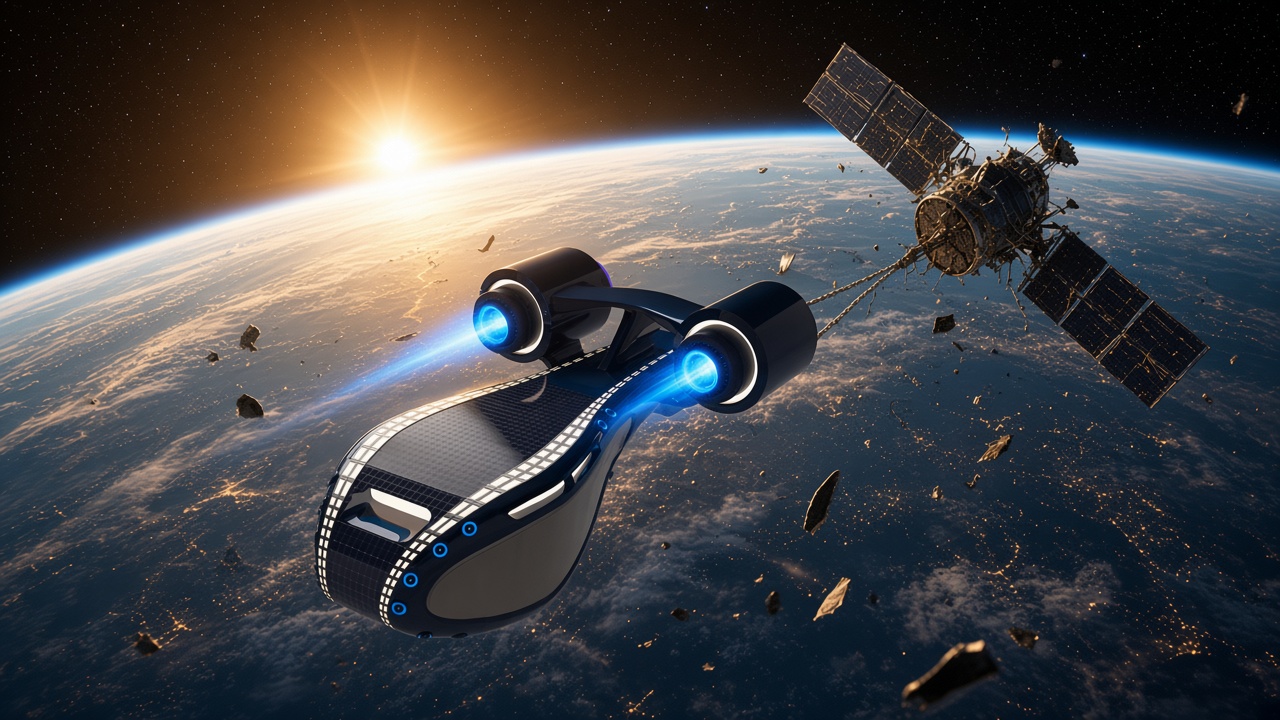
John Arwood, the inventor, is open to acquisition, licensing, or a development partnership for the Incognito concept. He is not asking the public site to negotiate those terms. He is making the invitation clear, and pointing serious parties to a direct conversation.
The right first step is Direct Communications. Tell the team whether you want to discuss acquisition, a license, or a joint development effort, and who should be on the first call.
Why a partnership conversation is timely
Commercial and government traffic in orbit is growing, and so is the leftover hardware that traffic leaves behind. The Incognito site already frames that as a waste-management problem, not only an engineering curiosity. Our Purpose quotes a 2011 National Research Council warning that derelict satellites and other debris have been accumulating for decades and could damage or destroy working spacecraft. It also argues that if waste in orbit is not planned for, the larger projects now being built — commercial flight, exploration, and the infrastructure around them — will stall.
A garbage truck does not replace the vehicles that carry people and cargo. It makes it more realistic for those vehicles to keep using the neighborhood. That is the opening for a partner who already builds launchers, operates constellations, insures assets, or has a mandate to keep orbits usable.
What has been developed so far
What follows is limited to what incognito.space itself already states. It is a concept-level body of work, not a claim that a vehicle has flown or that a production line exists.
The concept has a public home at incognito.space, with a stated architecture for the craft:
- A debris-first job. The vehicle is described as a self-sustaining orbital craft for collecting and hauling space debris, including debris larger than its own body, and for hauling satellites twice its size over a longer-than-average time and distance.
- Ion propulsion. Electromagnetic ion thrusters are proposed so the craft would need far less propellant, could go longer between refuelings, and could haul heavier loads over greater distances. The site correctly notes that this class of thruster is for in-space work, not for launch from the ground.
- Nuclear power with solar backup. A nuclear reactor is the main power source. Solar cells around the exterior provide backup, and power can be shifted — solar to the smaller side thrusters, main power to the larger rear thrusters — when the craft is hauling an oversized load.
- Maneuverability. Thrusters are described as placed all across the exterior, for rapid, controlled movement during the kind of close work debris collection requires.
- Modular add-ons. The site says components can be changed, switched, and attached in space so the same core vehicle can be configured for different jobs. It is a versatile platform with defense applications available to qualified government partners on request.
- A longer series. Asteroid mining is described as requiring in-space assembly with two other spacecraft in the Incognito series, aimed at S-type asteroids that can carry nickel, cobalt, gold, platinum, and rhodium. A name, Seraphim, is teased publicly as "Coming Soon," without a full specification on the site.
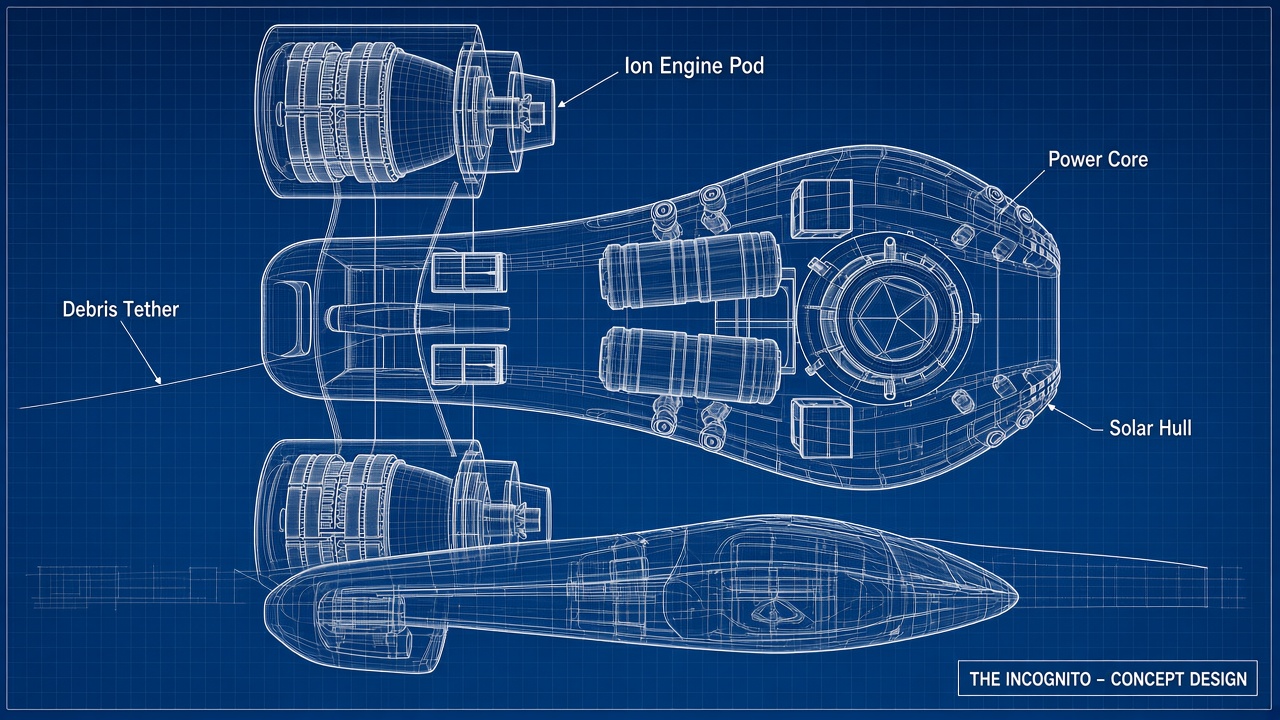
A proposed concept of operations — launch, low-refuel ion transit, locate, capture, and de-orbit so the debris burns up in the atmosphere — is set out on the overview page.
The idea is documented across Our Purpose, Our Specs, the FAQ, and a short overview of the concept. The Newsroom collects related writing, including pieces that invite industry leaders to look at the concept. There is already a public inquiry form on Direct Communications.
That is the honest inventory: a named inventor, a coherent public concept, a debris-collection mission, a described propulsion and power approach, a modular architecture, and an open door for partners. It is enough to start due diligence. It is not the same thing as a finished spacecraft, and this page will not pretend otherwise.
What an interested party can do next
A useful first conversation is specific. The outline below is a suggested path, not a contract.
- Read the public description. Start with the overview, then Our Purpose and Our Specs, so we are using the same language about what the concept is — and is not.
- Send a short inquiry. Use Direct Communications. Name your organization, your role, and whether you are exploring acquisition, licensing, a development partnership, or an information-gathering call. If you already have a technical or legal counterpart who should be included, say so.
- Share the constraints you care about. Operators and agencies usually need to talk about orbital regimes, interfaces, safety, and the form of any collaboration before anyone talks about schedules. Bring those constraints. The public site does not publish a performance envelope beyond the qualitative claims above, and a serious process should not invent one in the first email.
- Hold a focused discussion with John Arwood. The purpose of that meeting is to test fit: whether the debris-collection mission matches a real operational need, whether the partner would want to own, license, or co-develop the concept, and what information would be required for a second step.
- Decide on a formal next step. That might be a confidentiality agreement and a deeper briefing, a term sheet, or a polite stop. The public pages stop at the invitation. Everything after that belongs in a private channel.
If you are a qualified government organization exploring defense-related uses, use the same contact path and identify yourself clearly. Public marketing for The Incognito will not describe weapons or attack roles.
What this invitation is not
It is not a claim of funding, of a completed prototype, or of a relationship with any named launch or satellite company. It is not a request that a public figure endorse the concept. It is an open, specific invitation from the inventor to the organizations that might actually build, buy, or license a debris-collection craft.
John Arwood's background is in waste collection and disposal. The Incognito is that same kind of service, proposed for orbit. If your organization is responsible for keeping space usable — or for building the vehicles that will depend on it remaining usable — the conversation is welcome.
Start here: Direct Communications.